
The PCF8593T/1 I2C Real-Time Clock/Calendar: A Comprehensive Technical Overview and Application Guide
In the realm of embedded electronics, maintaining accurate time and date is a fundamental requirement for countless applications, from data logging and automation to consumer appliances. The PCF8593T/1, a robust I2C Real-Time Clock/Calendar (RTCC) chip from NXP Semiconductors, stands as a pivotal solution for this purpose. This article provides a detailed exploration of its architecture, functionality, and practical implementation.
Architectural Overview and Key Features
The PCF8593T/1 is a low-power CMOS device designed to provide a complete timekeeping solution. Its core functionality revolves around a real-time clock that counts seconds, minutes, hours, day, date, month, and year, with automatic leap year correction valid up to the year 2100.
A defining characteristic of this IC is its integrated 32.768 kHz oscillator circuit. This design significantly simplifies the external component count, requiring only a standard watch crystal and two load capacitors to form a highly accurate time base. The device operates on a wide supply voltage range, typically from 1.0V to 6.0V, making it suitable for both 5V and 3.3V systems and ideal for battery-backed applications. Its ultra-low power consumption ensures minimal drain on backup power sources.
Communication with a host microcontroller is streamlined via the industry-standard I²C-bus serial interface, supporting a maximum bus speed of 400 kHz. This two-wire interface (SDA and SCL) allows for easy integration with a vast majority of modern microcontrollers. The chip's 256 x 8-bit RAM offers substantial non-volatile storage for user data, which is maintained during power-loss when connected to a backup battery.
Critical Functionality: Alarms and Interrupts
Beyond simple timekeeping, the PCF8593T/1 enhances system autonomy through its programmable alarm and timer functions. It features a versatile alarm system that can be configured to trigger on a specific minute, hour, day, or date. Additionally, a built-in timer can generate periodic interrupts at selectable rates. These interrupts are output via an open-drain pin (/INT), which can be used to wake up a microcontroller from a low-power sleep mode, thereby enabling sophisticated power management strategies where the system is only active when necessary.
Application Guide and Circuit Implementation
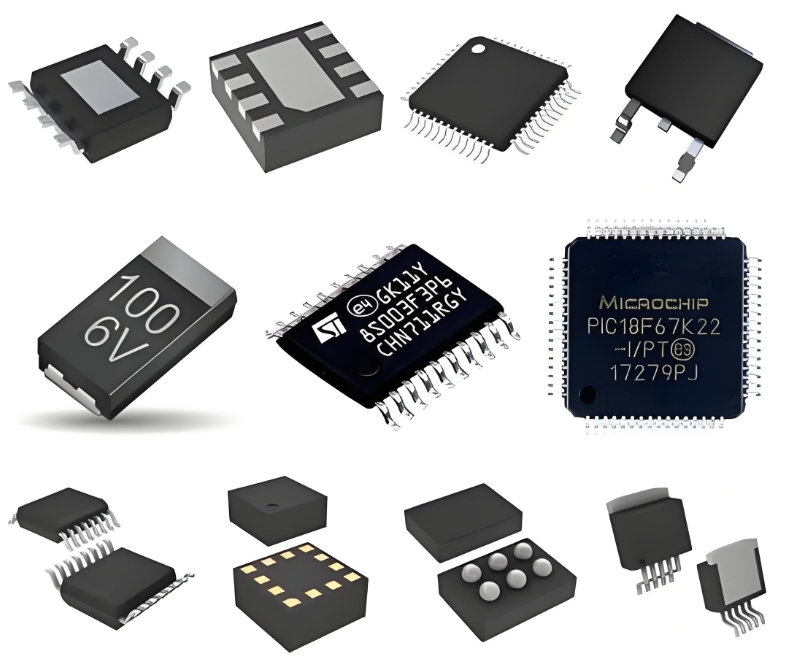
Implementing the PCF8593T/1 in a design is straightforward. A typical application circuit includes:
The PCF8593T/1 IC.
A 32.768 kHz tuning fork crystal.
Two load capacitors (typically 12-18pF each, adjusted for precision).
A 3V lithium backup battery (e.g., CR2032) connected to the Vbat pin.
Two pull-up resistors on the SDA and SCL lines.
The main power supply (Vdd) is connected to the system's rail. A simple diode-oring circuit, often using a Schottky diode, is commonly employed to automatically switch to the backup battery when main power is lost, ensuring uninterrupted timekeeping.
Software interaction involves initializing the clock by writing the correct time and date values to the respective registers. The microcontroller can then periodically read these registers to obtain the current time. To utilize the alarm, the desired alarm condition is written to the alarm registers, and the microcontroller configures the /INT pin as an input to respond to the interrupt.
The PCF8593T/1 is an exceptional and highly integrated real-time clock/calendar solution. Its combination of a built-in oscillator, extremely low power consumption, I²C interface, and powerful alarm features makes it an indispensable component for designers seeking to add reliable, sophisticated timekeeping capabilities to their embedded systems with minimal design effort.
Keywords: I²C-bus, Real-Time Clock (RTC), Low-Power, Backup Battery, Alarm Interrupt

